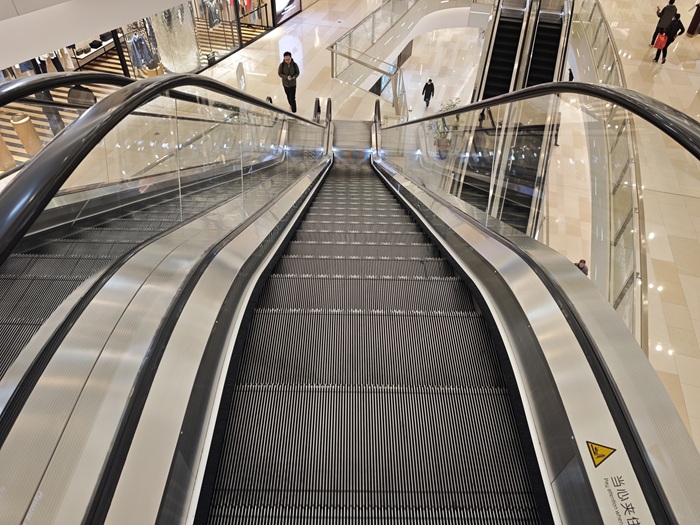
Escalator handrail dimension stability is critical to safe operation, reducing failures, and controlling maintenance costs. Most operational issues stem from shrinkage, deformation, and dimensional deviation in handrails over time, which can lead to various safety hazards.
Handrail dimension stability refers to a product’s ability to maintain its cross-sectional structure and overall dimensions during long-term use. A high-quality handrail adapts to repeated bending, temperature changes, and high-frequency friction, fitting the guide rail precisely without shrinking, deforming, or expanding.
Dimensional deviation directly leads to multiple escalator faults:
Shrinkage and Jamming: Shrinkage of internal materials squeezes the guide rail, increasing resistance and causing stalling, abnormal noise, or even slippage and drive system damage in severe cases.
Loose Fit and Derailment: Excessive clearance from loose edges leads to handrail misalignment, deviation, or even derailment, posing risks to passenger safety.
Accelerated Wear and Shortened Lifespan: Uneven stress accelerates local wear, cracking, and aging, shortening service life and increasing replacement and maintenance costs.
Linzhi Rubber & Plastic controls dimensional precision across every handrail through mature production processes and premium materials, offering both rubber and polyurethane series:
Rubber Handrails: Models such as RB8039S, RB8238O, and RB8041G feature low-shrinkage rubber formulations and high-strength skeletons for stable dimensions, wear resistance, and anti-aging properties, ideal for long-term use in high-traffic locations.
Polyurethane Handrails: Models including PU8040, PU7640, PU7638, and PU7238 ensure precise fit, ozone resistance, and easy cleaning, suitable for premium scenarios.
Contact: Jimmy
Whatsapp: +8613524534345
Email: jimmy@linzhichina.com
Add: No.15, Lane 518, Xin Bo Rd. Song Jiang, Shanghai, 201607, P.R. China