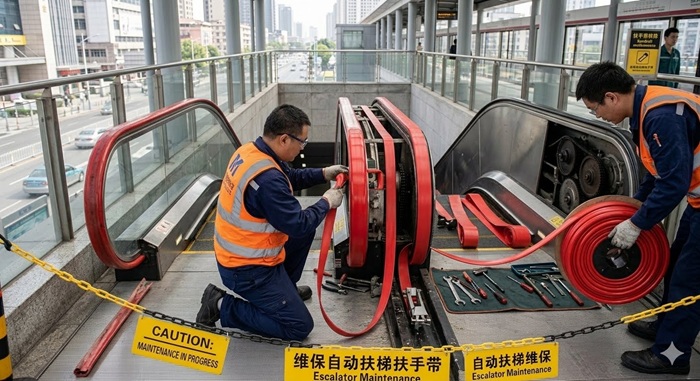
Statistics on escalator maintenance faults show that handrails on frequently started and stopped escalators age much faster than those on continuously operating units. Compared with steady constant-speed operation, repeated start-ups and shutdowns cause abrupt force changes, stress fatigue and intermittent friction — these are the hidden core factors leading to handrail deformation, premature aging and early replacement.
When an escalator runs at a constant speed, the tension and friction load on the handrail remain stable, resulting in even and gradual wear. Every start and stop generates instantaneous impact load: the tensile force surges at start-up, rapidly stretching the internal framework and base material; when shutting down, the tension is released and the material rebounds and contracts sharply. Repeated stretching and rebound over time accumulate irreversible fatigue damage to the material and cause structural aging. Meanwhile, sliding friction during start-stop phases is far more abrasive than regular rolling friction, accelerating surface deterioration.
Greatly shortened service lifeFrequent start-stop accelerates handrail aging remarkably. The material tends to harden and lose flexibility, accompanied by cracking, which drastically shortens the replacement cycle.
Tension loss and dimensional deformationRecurring instantaneous tension causes micro-stretching of the handrail framework and overall elongation. This leads to slack tension and dimensional deviation. Even after repeated adjustments, the handrail is prone to deviation, slippage and speed inconsistency.
Rapid wear of anti-slip patternsSliding friction during start-stop wears down the anti-slip textures on the handrail surface quickly, weakening anti-slip performance and raising the risk of passenger slippage. (For details, refer to: Relationship between handrail surface pattern design and anti-slip performance.)
Cracking and delamination at jointsHandrail joints are structural weak points. Subjected to continuous start-stop stress impact, they are highly susceptible to warping, cracking and adhesive failure.
Optimize operation logicAdjust the sensor delay settings to avoid frequent short-cycle start-stop and unnecessary no-load operation, so as to mitigate repeated stress impact.
Shorten maintenance and adjustment intervalsRegularly inspect handrail tension and alignment, and compensate for tension slack in a timely manner. Clean dust from guide rails and rollers to reduce extra frictional resistance during start and stop.
Adopt fatigue-resistant handrailsFor units with frequent start-stop operation, prioritize handrails made of high-toughness and low-shrinkage materials.Models including Linzhi RB8039S, RB8238O, RB8041G, PU8040 and PU7238 feature excellent tensile resistance and fatigue resistance. They can buffer start-stop impact and reduce deformation and aging, making them ideal for intermittently operating escalators.
Standardize maintenance operationsAvoid over-tightening the handrail during installation, as excessive tension combined with start-stop load will aggravate internal damage. Use neutral cleaning agents for routine maintenance to preserve the material’s flexibility and wear resistance.
Contact: Jimmy
Whatsapp: +8613524534345
Email: jimmy@linzhichina.com
Add: No.15, Lane 518, Xin Bo Rd. Song Jiang, Shanghai, 201607, P.R. China